2026 Top Rubber Heaters Innovations and Their Applications?

Rubber heaters play a crucial role in various industries. They provide efficient heating solutions for applications ranging from manufacturing to medical equipment. In 2026, innovations in this field have emerged, improving performance and versatility.

The advancements in rubber heaters focus on enhanced durability and efficiency. These innovations help in reducing energy costs. New materials offer better heat distribution and faster heating times. Industries are increasingly adopting these technologies for specific requirements.

Despite these developments, challenges remain. Some designs still lack optimal thermal responsiveness. These shortcomings require ongoing research and refinement. The future of rubber heaters promises exciting prospects, yet there is much to improve. Such reflections can guide manufacturers in enhancing their designs.

2026 Top Rubber Heaters Innovations and Their Applications?

Overview of Rubber Heater Technology and Innovations in 2026

In 2026, rubber heater technology sees significant advancements. New materials enhance performance and energy efficiency. These heaters now offer better flexibility and durability. This is crucial for industries with demanding environments. They are capable of withstanding extreme temperatures while maintaining consistent heat distribution.

Recent innovations include smart heat controls. These systems allow for real-time monitoring and adjustments. Users can optimize energy consumption based on specific needs. This integration of technology makes rubber heaters more user-friendly. However, concerns arise about the complexity of these systems. Not everyone is tech-savvy. Training may be necessary, which can deter some users.

The rubber heater's applications are diverse. They are used in automotive, aerospace, and manufacturing. Each sector benefits from the ability to maintain precise temperatures. Yet, there are challenges. Installation can be tricky, and not all buildings can accommodate them. Future developments should aim to simplify these processes. Balancing innovation with accessibility remains a key focus for the industry.
Key Features and Advantages of Modern Rubber Heaters

Modern rubber heaters offer innovative solutions for various applications. Their design features include flexible materials and efficient heating coils. This combination allows for uniform heat distribution across surfaces. Such technology is crucial in industries like manufacturing and food processing. Users can benefit from improved operational efficiency.


One key advantage of modern rubber heaters is their adaptability. They can be used in different environments, from harsh industrial settings to sensitive laboratory spaces. This versatility is often underestimated but essential. The heaters can conform to various shapes and sizes, which traditional heaters struggle to achieve. This feature makes them highly practical.


However, challenges remain. Not all rubber heaters perform equally well under extreme conditions. Some may degrade faster than expected. Users should consider their specific needs and potential limitations. Regular evaluation may prevent issues down the line. Balancing innovation and performance is vital for optimal use.

Diverse Applications of Rubber Heaters in Industry and Daily Life

2026 Top Rubber Heaters Innovations and Their Applications?

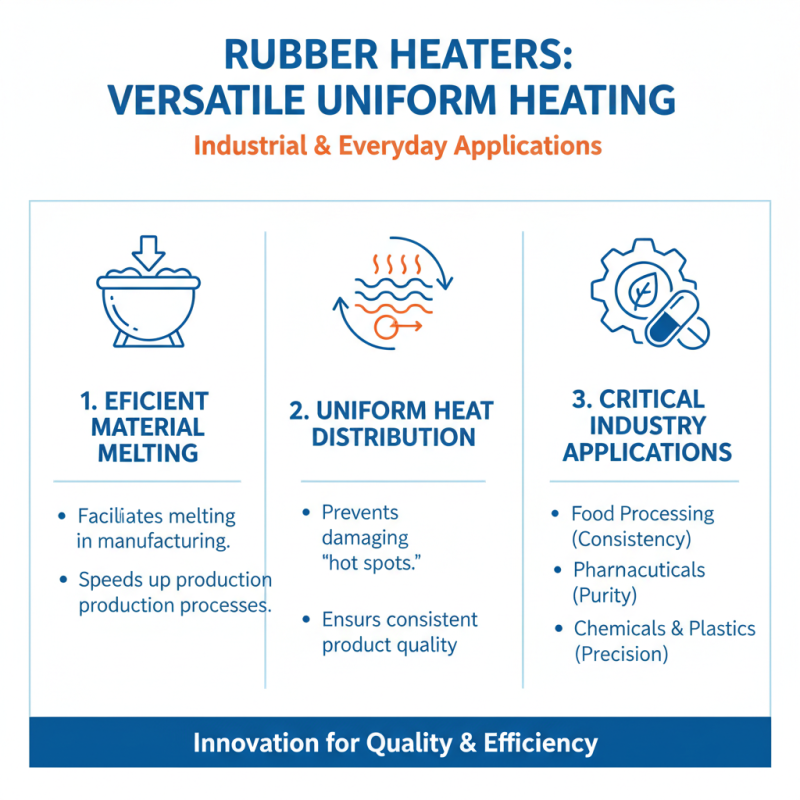
Rubber heaters are versatile tools in various industries and everyday applications. In manufacturing, these heaters enable the efficient melting of materials. They ensure uniform heat distribution, preventing hot spots that could ruin products. This application is critical in industries like food processing and pharmaceuticals, where consistency is key.

In daily life, rubber heaters find use in heat therapy. Many people rely on them for pain relief in muscles and joints. They provide comfort during cold weather, warming blankets and clothing. However, some consumers may overlook safety guidelines, risking burns or accidents. It is essential to understand the risks associated with improper use.

Moreover, rubber heaters contribute to automotive applications. They are used for defrosting windshields and maintaining engine temperatures. This innovation is crucial for drivers in cold climates. Yet, the efficiency of these heaters can vary based on design and installation. Regular checks are important to ensure optimal performance. By considering these details, users can maximize the benefits of rubber heaters in both industrial and daily life.

Environmental Impact and Sustainability of Rubber Heating Solutions

The environmental impact of rubber heating solutions is an important topic for industries today. Innovations in rubber heaters can lead to better energy efficiency. For instance, recent reports indicate that advanced rubber heating technologies can reduce energy consumption by up to 30%. This is significant given the rising energy costs worldwide. Moreover, these solutions often utilize materials that are recyclable or derived from sustainable sources.

Despite these advancements, challenges still exist. Many rubber heaters are not designed with full environmental consideration. For example, the production of rubber can generate significant waste and emissions. The industry must strive to minimize this footprint. The reality is that the shift to greener alternatives is often slower than desired.

Furthermore, while many companies are moving towards more eco-friendly practices, the variability in manufacturing standards complicates the situation. A report by the International Rubber Study Group highlights that only about 15% of rubber manufacturers adhere to strict environmental guidelines. This raises questions about true sustainability in the sector. Continuous innovation is essential, but it needs to align with stringent environmental standards. The balance between technological advancement and ecological responsibility remains a critical area for improvement.

Future Trends and Developments in Rubber Heating Technology

The rubber heating technology market is evolving quickly. Innovations in this field aim to enhance efficiency and performance. According to recent industry reports, the market is projected to grow at a CAGR of 5.4% through 2026. This growth reflects increased demand in sectors like automotive and aerospace.

Emerging trends focus on smart heating systems. These systems can adjust temperatures based on real-time data. Such advancements minimize energy waste and improve product lifespan. Further, the integration of IoT can enhance monitoring and control of heating processes. However, many companies still struggle to implement these technologies effectively.

Another crucial aspect is the material used in rubber heaters. New compounds are being developed to withstand higher temperatures and improve durability. Statistics reveal that 45% of manufacturers report issues with material rigidity at elevated temperatures. Addressing this concern is vital for the future. Companies must balance innovation with practical applications to meet industry needs.