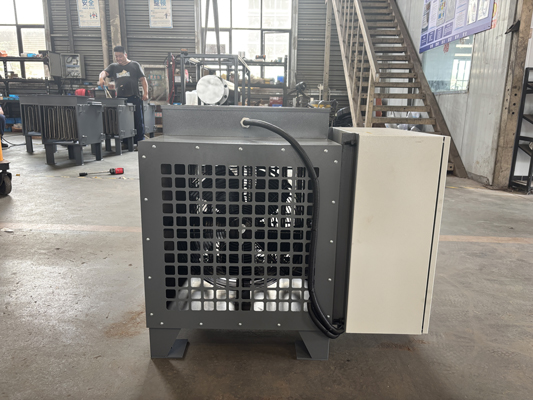
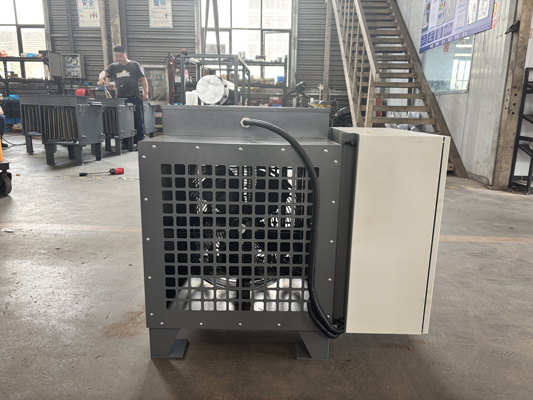
The industrial electric heating air warmer is an industrial-grade heating device that uses electricity as the heat source and achieves air heating through forced convection via a fan. It is widely used in large-space scenarios requiring rapid temperature rise, such as workshops, warehouses, greenhouses, and construction sites.
First, the basic composition
It mainly consists of three major components: the heating unit (electric heating tube / finned heater), the air delivery unit (centrifugal fan / axial fan), and the control unit (temperature controller / overheat protector / power switch). High-end models also feature additional modules such as temperature sensors, timer functions, and remote operation.
Second, the heating principle
After power-on, the heating element quickly generates heat. The built-in fan drives air to flow rapidly over the heating surface. The heated air is then blown out through the vent, while cold air is replenished from the intake, creating a continuous air circulation. Compared to traditional radiant heating, forced convection offers higher heat exchange efficiency and more uniform overall space warming.
Third, Core Technical Parameters
• Power range: Commonly 3kW-30kW, some industrial-grade models can exceed 50kW
• Operating voltage: 220V single-phase for low power, 380V three-phase for high power
• Outlet air temperature: Standard type 50-80°C, high-temperature type up to 150-300°C
• Airflow: Ranges from several hundred to several thousand cubic meters per hour
• Temperature control accuracy: Ordinary knob type ±5℃, digital PID type ±1℃
Fourth, the main advantages
• Instant heating: Hot air is produced within minutes after startup, eliminating the need for preheating
• Flexible installation: Mobile with casters for easy transport, wall-mounted or ceiling-mounted to save floor space
• Clean and Environmentally Friendly: No combustion exhaust, no oil stains, no open flames, meeting environmental protection requirements
• Automatic constant temperature: Automatically stops when reaching the set temperature and starts when it falls below the set temperature
• Safety Protection: Most models are equipped with multiple safeguards, including overheat protection, overload protection, and power-off in case of tipping
Fifth, Typical Application Areas
•Industrial Production: Whole workshop heating, supplementary heating for production line workstations, and winter freeze protection for equipment
• Warehouse and Logistics: Warehouse insulation, cargo moisture-proofing, and heating in sorting operation areas
• Agricultural Breeding: Greenhouse Heating, Brooding and Insulation in Livestock Sheds, Edible Mushroom Cultivation
• Construction Engineering: Winter Construction Maintenance, Concrete Drying, Accelerated Drying for Interior Decoration
• Commercial Public: Temporary Heating for Exhibition Halls, Stadiums, Stations, and Large Supermarkets
Sixth, Key Selection
Power is the primary indicator. The required kilowatts are generally estimated by multiplying "cubic space per unit × temperature difference × 0.06," then adjusted based on ceiling height, insulation conditions, and target temperature. Models with 380V three-phase power supply offer more stable heating efficiency and are suitable for prolonged continuous operation. Special environments (anti-explosion, waterproof, anti-corrosion) require the selection of corresponding specialized models.
If you want to know more about our product, please contact us!
Post time: Aug-21-2026