Top Tips for Choosing the Right Thermal Coupler for Your Needs?
Choosing the right thermal coupler is crucial for precision applications. According to industry reports, thermal couples account for over 70% of temperature measurements in industrial settings. Their reliability directly impacts productivity and safety in various fields, from manufacturing to aerospace.
In a world where accurate temperature control is vital, understanding thermal couples becomes essential. The variety in types, such as J, K, T, and E, can be overwhelming. Each type has its specific applications and limitations. For example, K-type thermal couples are common due to their wide temperature range but may not be suitable for all environments.
Investing in the correct thermal coupler can prevent costly errors. Many users overlook factors like material compatibility and response time. Choosing poorly can lead to inaccurate readings, resulting in equipment damage or unsafe conditions. Therefore, careful consideration of your specific requirements is necessary. Balancing cost and performance often requires expert insight.
Understanding the Basics of Thermal Couplers and Their Functionality
When choosing a thermal coupler, it's essential to understand its basic functionality. A thermal coupler converts temperature differences into electrical signals, providing crucial data for temperature monitoring. According to industry reports, 35% of equipment failures are attributed to inadequate temperature control. This highlights the importance of selecting the right thermal coupler for your specific application.
There are several types of thermal couplers, including thermocouples and RTDs (Resistance Temperature Detectors). Thermocouples are versatile and can measure a wide range of temperatures. They are often used in industrial applications. RTDs, on the other hand, offer higher accuracy but at higher costs. Data shows that the accuracy rate of RTDs can exceed 0.1%. However, this level of precision may not be necessary for all operations.
Consider your specific requirements. For instance, if your application involves extreme temperatures, you'll need a type that withstands high levels consistently. Some users report having problems with thermal lag. This is when there is a delay in temperature reading due to the thermal coupler's response time. Not all thermal couplers are created equal. Research the specifications, as this can make a significant difference in performance.
Top Tips for Choosing the Right Thermal Coupler for Your Needs
| Dimension |
Description |
Recommended Applications |
| Thermal Range (°C) |
Operating temperature limits for accurate readings. |
Industrial processes, HVAC systems. |
| Response Time |
Time taken to respond to temperature change. |
Fast-paced applications, automotive testing. |
| Material |
The conductivity and durability of the material used. |
Electrical systems, chemical processing. |
| Mounting Type |
How the thermal coupler is installed. |
Machinery, electronic devices. |
| Output Type |
The signal format produced by the coupler. |
Data logging, process control systems. |
Types of Thermal Couplers and Their Applications in Various Industries
When selecting a thermal coupler, understanding the diverse types available and their specific applications is crucial. In industries like manufacturing and aerospace, thermocouples are integral for accurate temperature measurement. The most commonly used types are Type K and Type J, known for their versatility and reliability. A report from the International Society of Automation highlighted that Type K thermocouples cover a temperature range of -200 to 1,250 degrees Celsius, making them suitable for a variety of processes.
In the food industry, thermocouples play a critical role in temperature monitoring during cooking. Type T thermocouples are particularly favored here, as they provide reliable readings at low temperatures. This precision is essential in ensuring food safety and compliance with health regulations. According to a 2021 report by Food Safety Magazine, the use of accurate temperature sensing has reduced cooking errors by 35%, emphasizing the importance of choosing the right thermal coupler for specific applications.
The oil and gas industry often employs Type E thermocouples for high-temperature environments. These sensors can withstand extreme conditions, with a temperature range of up to 900 degrees Celsius. However, there are challenges in material selection and potential interference from electromagnetic fields. Organizations must evaluate their unique requirements carefully to avoid costly mistakes. Understanding these nuances is key to making informed decisions when choosing thermal couplers for various sectors.
Thermal Coupler Applications in Various Industries
Key Specifications to Consider When Selecting a Thermal Coupler
When selecting a thermal coupler, several key specifications come into play. Start with the temperature range. Different applications require couplers that can withstand various temperatures. For instance, industrial processes often involve extreme heat, necessitating couplers with higher tolerance levels.
Next, consider the wire type and insulation material. Thermocouples can be made from various metals, each offering unique properties. The choice of insulation also affects performance. Some materials can handle harsh environments better than others. Evaluating these details ensures optimal functionality.
Lastly, pay attention to the response time. A rapid response is crucial in many applications, especially in critical monitoring situations. Couplers with better response times can lead to more accurate data collection. Reflecting on these specifications helps in making a more informed choice. Remember, taking time to assess your specific needs is vital.
Factors Influencing the Performance and Accuracy of Thermal Couplers
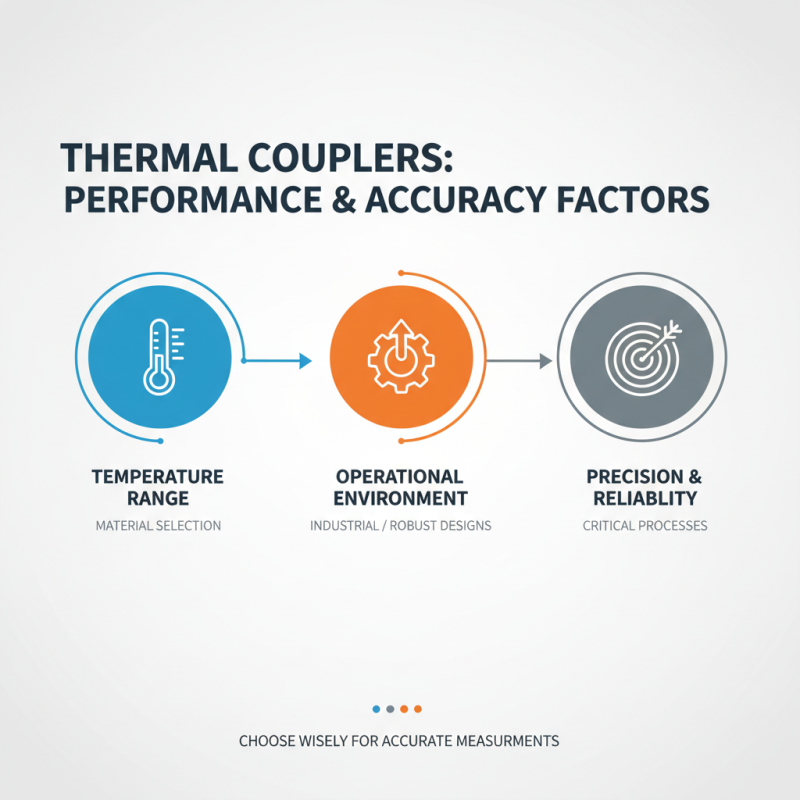
When choosing a thermal coupler, various factors can significantly influence its performance and accuracy. Temperature range is crucial. Different materials respond to temperature changes uniquely. A poorly selected coupler may lead to misreadings. This can impact processes where precision is vital. Understanding the operational environment is essential here. For instance, industrial settings often demand robust designs.
Another factor is the response time. Some thermal couplers react quickly, while others may lag. Consider the specific application’s needs. A fast response time is necessary in dynamic systems. Alternatively, slower systems may not require this feature as critically. The installation location also matters. If a coupler is in a high-vibration area, it could wear out faster.
Calibration routines are another consideration. Regular calibration ensures accuracy. A coupler that drifts over time can yield unreliable readings. Additionally, user experience plays a role. A user’s familiarity with installation techniques affects outcomes. All these aspects contribute to the optimal selection of thermal couplers. Assessing them thoughtfully can prevent unforeseen challenges down the line.
Tips for Proper Installation and Maintenance of Thermal Couplers
When it comes to thermal couplers, proper installation and maintenance are crucial for optimal performance. The American Society of Mechanical Engineers (ASME) indicates that improper installation accounts for nearly 30% of thermal measurement errors. It’s essential to ensure the thermal coupler is securely fixed to the measurement surface. A clean surface free of debris ensures better contact and more accurate readings.
Regular maintenance is equally important. Routine inspections can help identify wear and tear, which could compromise accuracy. According to a recent industry report, 25% of operators overlook these checks, leading to significant temperature drift in readings. Tightening connections and checking insulation should be part of your regular maintenance routine. Consider using thermal paste to enhance conductivity. While it can improve performance, improper application may result in increased error. Balancing these aspects is essential for maintaining reliability in thermal measurements.